Showing posts with label Peru. Show all posts

Monday, 23 June 2014

The Travelling Miles Incredibility Awards - South America

While I've got some down-time here in Melbourne now I'm jobhunting and sorting my life out, I thought a bit of a reflection of my three months in South America was in order.

I loved my time there, and I can't put my finger on the best bit, so let's try for best bits. 

I can only comment on where I've been, so the following delightfully TMI Awards will be allocated to Brazil, Paraguay, Argentina, Peru, Bolivia and Chile, and cities/places within. 


Best cities: 

1. Rio de Janeiro, Brazil. 


The sun, the sand, the parties. I miss it already. 

2. Valparaíso, Chile. 


A vivid graffiti-infused seaside culture bomb. 

3. Buenos Aires, Argentina. 


Sexy tango dens mixed with European-style glamour. 


Worst cities: 

1. Uyuni, Bolivia. 

The only reason to go is the salt flats. 


2. Ciudad del Este, Paraguay. 

The only reason to go is to get the passport stamp. 


3. Lima, Peru. 

The only reason to go is to leave. 


Most impressive natural wonders: 

1. Iguassu Falls, Argentina-Brazil border. 


Unforgettable sights at every turn. The Devil's Throat is unmissable. 

2. The Amazon Rainforest, Peru (for me). 


A wonderland of natural beauty, calm waters and life as you've never seen it. 

3. Salar de Uyuni, Bolivia. 


A pure, surreal landscape dotted with glowing mirages. 


Most impressive manmade wonders: 

1. Machu Picchu, Peru. 


Not original, but nothing else beats it for me. 

2. Rio Carnival Samba Parade, Sambodromo, Brazil. 


The most colourful, insane night of my life. Stay til sunrise to get the most out of it. 

3. Humberstone, Iquique, Chile. 


A deserted mining town now half-reclaimed by the world's driest desert. 


Best beach: 

Ipanema, Rio de Janeiro, Brazil. 


Hands down the best. Watch sunset from the rocks - absolutely gorgeous. 


Best mountain scenery: 

Bolivia. 


The volcanic colours were fantastic, against a backdrop of pure blue sky. 


Best landscape: 

Valle de la Luna, San Pedro, Chile. 


Watch sunset over the smoking volcanoes and watch the yellows turn to reds and purples over the pockmarked desert valley. 


Best sunrise: 

Machu Picchu, Peru. 


It's an unconventional sunrise, but the shafts of golden light illuminating the city on the mountaintop was a sight to behold. 


Best sunset: 

Middle of freakin' nowhere, Bolivia. 


I don't need to add anything to this photo. 


Easiest Spanish to understand: 

Peru. And everyone loves the Colombian accent. That's where I'm going to study it, in my dreams. 


Hardest Spanish to understand: 

Chile. Like, seriously. 


Most welcoming people: 

Chile. Like, seriously. 


Least welcoming people: 

It's a toss-up between Peru and Bolivia, which I think is linked to the poverty levels. 


Safest country: 

Chile. But still watch your stuff. 


Least safe country: 

Peru. I felt unsafe in Peru more than any other place. Just exercise caution. 


Easiest country to get around: 

Peru. Extensive bus network, and you can book online with ease if necessary. 


Hardest country to get around: 

Brazil. Foreigners can't book buses online, and also the country is massive, but that's not Brazil's fault. 


Places that most deserve a re-visit: 

1. Argentina. I want to explore so much more of that beautiful country, especially Patagonia in the south. 

2. Rio de Janeiro, Brazil. What can I say? I fell in love with that place. 


And 3. The whole damn continent.


#TMIawards #TMI


Wednesday, 7 May 2014

Oh Valpo

I survived my 24 hour bus journey! It was intense at times, and I kind of hated myself for not spending twice the money on a two hour flight, but in the end money lasts longer than the discomfort.

And they played some alright films, so I barely listened to my iPod and I didn't touch my book. So I suppose that's a good thing. 

And it was absolutely worth the long trip to be here in Valparaíso. It is such a beautiful city. It's actually vying for the top spot of my favourite South American cities, which at the moment is held by Rio. I'll see how I feel in a few days, but it's close. 

Valpo is a seaside town about two hours west of Santiago. It's funky and arty, and full of interesting graffiti on the sides of multicoloured houses, opposite old colonial churches, all built into a hillside traversed by funicular trams overlooking the Pacific. 


I've fallen in love, and I've been here for seven hours. When I stepped off the bus, into the sun and fresh air (!), it seemed like everyone was smiling. There's a definite feeling of good vibes here, and I don't think that's just me being high off sea level air after coming down from the mountains. 

I've got tomorrow here as well, and then I'll rustle me up a bus to Santiago in the evening. A friend of a friend is meeting me at the bus station and we're going for dinner, and on Friday night I'm going to meet up with the French-Colombian couple I met in Bolivia. A nice final few days in South America. 

So while I'm lying on this very comfortable bed in a Valpo and cheap Chinese food-induced coma, I think I'll prattle on about Chile in general. Oh, but first, speaking of this bed - I'm staying at Casa Volante Hostel, and it's lovely. Very welcoming, great showers, kitchen and common room. And not too expensive either. There's a Miles recommendation for you. 

So Chile. I really like Chile. It's one of my favourite countries I've been to on this trip, up there with Brazil and Argentina for atmosphere and general buzz. 

The people are incredibly warm, welcoming and patient with foreigners who don't speak Spanish very well (ie me). Much more so than in Peru. I often found the average Peruvian seemed to have a bad taste in their mouth when they came into contact with foreigners, and it was the same in Bolivia. I wonder if there's a correlation between the wealth of the population and the friendliness towards tourists. There could be some disdain in the poorer nations. But anyway, that's not the case in Chile, because I've found Chileans to be the most open of all South American people. 

It's a country of incredible contrasts, with the north being enveloped in the world's driest desert, and the south bring home to Patagonia, a wonderland of snowy mountains, glaciers and perfect lakes. Unfortunately I won't make it any further south than Santiago, but I'm hoping that New Zealand will fulfil my need for fabulous scenery. And Chile doesn't have Mt Doom. 

Chile doesn't want you to buy anything. In shops that are any more specialist than an average corner shop, you'll have to tell the person behind one counter what you want, then take a ticket to another counter to pay, where you'll be given a receipt to collect your items from a third counter. Jobs for all! 

Chile is still a developing country, but the government is aiming to become a first-world country by 2020. And it's well on its way. It has a good infrastructure, helped enormously by the impressive Pan-American Highway that runs north to south. Things also seem to work here, which is nice after spending over a month in Peru. And Chile's economy is strong, which leads me to my next point. 

Chile isn't cheap. After coming from Peru, it was a bit of a shock. I haven't spent £10 on a dormitory room since Rio, but northern Chile seems to think rather highly of itself. But it is a nice country, so I'm prepared to spend a bit more to be here for a while before I jet off to the second "other side of the world" of my trip. 

In short... Chile. I'm a fan.

Saturday, 26 April 2014

Tacna, Peru to Arica, Chile by Bus

Yesterday I left Peru and the five weeks there behind me, and entered a new country! I was really excited to go to Chile, if only for a change of scene. But also I can't wait to explore the Atacama desert.

I got a Flores bus from Arequipa to Tacna, which was advertised as taking five hours, but actually took six. The journey south was through very rugged terrain at times, the road clinging to the sides of valleys seemingly made entirely of golden scree. Then we went into the desert proper, and I had my first views of all-encompassing, horizon-hugging nothingness, only broken occasionally by the waltz of power cables across the landscape. 


I met a very nice couple on the bus, Amy and Cody, and they were going to Arica as well, so we tackled the border together. Arriving at Tacna you need to cross the road to the international bus station and find one of the many people asking if you want a colectivo to Arica, which is basically a taxi which they fill with people and then go. It cost us 20 soles per person. 

They take your passport from you to print off a small form which you need at Chilean immigration. Keep that safe! 

It's 20km to the border from Tacna, and then a further 20km to Arica once you're in Chile. Despite being directly south, Chile is in a different time zone, and due to daylight saving time we lost two hours, despite my iPod insisting Chile was only an hour ahead. There is a digital clock when you go through to prove Apple wrong. 

Then our driver took us to the bus station in Arica and dropped us and our bags there. The three of us bought tickets for our onward journeys, Amy and Cody to San Pedro, and me to Iquique for this morning. 

We walked along the beach, just in time to see a gorgeous sunset, and had dinner near the main plaza. Arica is a really relaxed surfing town, and I liked it a lot, even though I was only there for one night. 


It was also really nice to be back at sea level, as for the last four weeks I've been at least 2,500 metres up in the mountains. But oddly I didn't feel any different, other than not being out of breath after taking two steps. I guess I had properly acclimatised to the thin air, which I suppose is a good thing. 

Right now I'm lying on a very comfortable sofa by a window overlooking the front patio of my beach-adjacent hostel in Iquique, and tomorrow I'm doing a tour to the nearby mining ghost towns and oasises. No complaints my end. 


Friday, 25 April 2014

Colca Canyon

On Wednesday I went on a two-day tour to Colca Canyon, which at its deepest point is twice as deep as the US' Grand Canyon. The tour was organised by my hostel, Wild Rover, and cost 70 soles for the transport, guide, accommodation and breakfast. We had to buy the boleto turístico to actually enter the Canyon separately though, which was an extra 70 soles.

The day before we left I'd spent the day with the girls I met in Rio, and in the evening Camilla, who I met in the same hostel, arrived, so it was a great little ReRionion over tequila sunrises in the Wild Rover bar. 

We were up to leave at 8am and headed out into the mountainous desert in our minibus. We stopped to buy coca products to combat altitude sickness, because to get to Colca Canyon from Arequipa you need to pass over a point that reaches 4,910 metres high. That's now the highest I've been in my life, and I actually felt fine. Maybe the coca sweets did their job really well! 

We arrived in Chivay, the town at the closer end of the canyon, for lunch and an afternoon at natural hot springs along the bank of the river, only accessible by way of a rope suspension bridge over the rushing waters. I met a group of three who had actually met the girls from Rio earlier in their trip, and we spent the next two days together. 

After dinner and a dance performance, which involved me being put on the floor and actually whipped by a woman in traditional dress (don't ask), we got an early night in preparation for our 5.30am start the next morning. 

But it was worth the early hour and the freezing cold, because we got to the Cruz Del Condor viewpoint in time to see the magnificent birds in flight. I'd been around condors at the zoo I volunteered at, but never seen them catch the warm air currents and glide. Really something. 


Apparently it's not easy to see them in flight, but someone in my tour group pointed out that there was a dead cow on a ridge below us, so maybe they're drawn there on purpose for the 9am tourist influx. 

And the canyon itself. Wow. It stretches down to the white river past ridges, pre-Inca terraces, the occasional condor if you're lucky... It's a very impressive sight. But wear sunscreen! I got so burned that morning, and ended up in bed early with sunstroke and a tomato face when we got back to Arequipa. Not a good look. 

We did a short hike along the top of the canyon, and stopped at various points on our way back to Chivay. Each view brought a new sight. If you have time while in Arequipa, this is a highlight you shouldn't miss. Whether you do it in a tour, or by yourself with local buses, you'll have a great time. 


Monday, 21 April 2014

Arequipa

I'm now in Arequipa, Peru's White City. And its second largest city as well. I was prepared to be a bit meh, as I was with Lima and Puno, but Arequipa has earned itself second place after Cusco in my world-famous ranking of Peruvian cities.

I've stayed in two hostels, both in the historical centre, so I can only comment on the area with the cathedrals and pretty buildings. It's this area that gives Arequipa its nickname as the White City, thanks to the volcanic stone the buildings were made from. 

But the best thing about Arequipa is its setting on a plain beneath three snow-capped active volcanoes. My first hostel, Park Hostel, was in a nice colonial building with a fabulous roof terrace that looks over the roofs of the centro histórico over to the volcanoes. What a sight for breakfast. 


From here you can do all manner of trips, including white-water rafting, mountain/volcano climbing, and hiking. Not being an adrenalin-junkie myself, I'm doing a one-night two-day trip to Colca Canyon, which is one of the world's largest canyons, even outdoing the Grand Canyon. That's Wednesday-Thursday, so I've got tomorrow to explore Arequipa some more. 

But the girls I met in Rio (god that feels like ages ago, and it was only two months) are joining me in the hostel I'm in now. It's a full on party hostel, The Wild Rover, which also has branches in La Paz and Cusco. I haven't stayed in a lively hostel like this before. I love a good party, but I tend to like my partying and sleeping to be in separate places. We'll see I guess. Got to try these things! I'll pretend I'm a one-man lads on tour group. 

So anyway, it'll be really nice to see them again. I assume we'll do some kind of sightseeing tomorrow, then I've got Colca Canyon for two days (booked through the hostel - 75 soles for the one-night tour). And then I've booked a bus for Tacna on Friday, and from Tacna I'll go by bus to Arica, in Chile. Then it'll be goodbye to Peru! 

Oh also, I took a Cruz Del Sur bus from Puno to Arequipa, and it was very comfortable. Cruz Del Sur is generally regarded as the safest bus company to travel with in Peru, so it's a bit more expensive than you'd pay with other companies. It cost me 59 soles for the cheaper level (top level) for the five and a half hour trip here. There was a small snack included, and blankets! You still don't get a choice about whether to hear the films they played on the overheard screens though. Four hours of Ben Hur and I was ready to Ben Hurl. But then they played Tangled, which I'd actually wanted to see when it came out. Well done Cruz Del Sur. 

Anyway, my lively hostel awaits my presence. Will update soon! 

Friday, 18 April 2014

Island Tour on Lake Titicaca: The Perfect Storm

Today I went on a day trip from Puno to Uros and Taquile, two islands on Lake Titicaca. And as the title of this post would suggest, it was not the smoothest boat trip I've ever been on. In fact, it was easily the most dramatic. But we'll get to that later. 

Lake Titicaca is the world's highest navigable lake, sitting at 3808 metres high and spanning a whopping 8400km. And it's a beautiful place. It's just Peru's lakeside cities that are a bore. Puno is the dullest place I've been to on my trip so far. I'd even take Lima over Puno. But I'm here for the Lake, not the cities. 

You can do half-day boat trips to just the Uros Islands, full-days to Uros and Taquile, or an overnight which includes Amantani as well. I did the full-day option, which cost 70 soles arranged through my hostel, and included pick-up and drop-off at my hostel, boat trips for the day and lunch on Taquile. 

So without the clocks striking thirteen, or anything else ominous, we left the dock at about 7am, in the freezing cold. Just a note, Lake Titicaca is cold when the sun isn't out. The days are a mixture of t-shirt and hat and scarf weather. 

It took an hour and a quarter to get to the Uros Islands, which gave me time to take in the wide blue skies, glittering clear water, and the islands of reeds underlining snowy mountains on the Bolivian shore of the lake. Uros is a group of manmade floating reed islands, each with half a dozen families living in reed houses, sailing reed boats. 

Stepping onto the island we visited felt like jumping onto a bouncy castle. Underneath the layers of reeds is springy wet earth, anchored to the lakebed with, you guessed it, reeds. And it was a really tiny place. There was a 'square' of sorts with all the houses surrounding it in a circle. It was a surreal experience, wandering round the stalls the locals had set up (caution: it's very touristy), all the while thinking that you're walking on bobbing reeds. All the houses had solar panels as well. Doing better than the UK already. 


Another hour and 20 minutes away was Taquile, a natural island. It was tall, with its summit just overtaking the 4000 metre mark. It was a place of vibrant greens and blues, and steep paths climbing to where we had our lunch of trout from the Lake near the main plaza. Lunch was followed by a traditional dance, which involved some audience participation. There was also a finger post to different cities in the world in the plaza, which took up most of my photographic energies. I met some really cool Brazilians who work in London, so we spent most of the afternoon chatting. 

At about 2.30pm we left Taquile and started the three hour journey back to Puno. We left with beautifully clear sky, and a rosy pink neck in my case. But it quickly clouded over. I'd been expecting this, as pretty much every afternoon I've had in Peru has ended up with some rain. 

This was more than some rain. The wind was whipping round the boat, rain hammering against the windows, and the waves creating a rollercoaster of water, the mountains disappearing in splashes of grey every few moments. I kept my eyes on the horizon to avoid seasickness, which worked very well. This had been going on for about 15 minutes, and I was contently bouncing around listening to Ke$ha. That's when the front window smashed in. 

A huge wave had reared up and thrown the majority of the window on top of the driver. He and the first two rows of passengers were soaked, glass floating around on the floor. No one quite seemed to know what to do. The boat was still rising and plummeting with every wave. 

The driver was okay, save cuts on both hands. But water was still splashing inside the boat, the structure creaking with every rise and fall. I heard a woman throw up behind me. 

One of the Brazilian girls at the back of the boat started to hand out life-jackets. She called out my name and gave me the first one, but my conscience forced me to pass it down to the front, and that continued until they were all gone. And there wasn't one left for me. Great health and safety, Peru. 

There was a life-ring though, for four of us without jackets to share. The storm continued for half an hour, but it felt like a lot longer. We finally rounded the peninsula and the wind died down, leaving us bobbing rather than ferociously dipping. 

Everyone was calm, and once the waves subsided and the driver had seen to his hands and thrown the shattered glass overboard the Titanic jokes and calls of "Jack!" began. 

It did get choppy again, but the driver had left the boat on automatic. Even when other boats came worryingly close he didn't seem phased enough to re-take the wheel. 

And by the time we pulled into the dock at Puno the weather had calmed down a lot. The wind was still strong, and cold, but we were mainly unscathed. 

And that ended my Lake Titidrama. It was quite enough excitement for me for one day. Tomorrow I'm going to Arequipa, which sits between several active volcanoes on the northern corner of the world's driest desert, so I think I'll be safe from water there. Just got to hope my arrival doesn't trigger an eruption, ey? 

Thursday, 17 April 2014

Farewell Cusco

As a note, this post is not meant to be in Spanish! A computer I was using when I wrote it changed it automatically. As soon as I figure out how to translate it back I will.

Yo lo he hecho! He abandonado la nave. Cortar los lazos sueltos. Tuve que salir del agujero cómoda que había pasó tres semanas acariciando dentro y salgo de mi familia anfitriona, mi hermana de acogida, y mi rutina de voluntariado atrás.

Para compadecer mi última noche Sarah y yo nos fuimos de nuevo a la cafetería en la Avenida El Sol, Amorino, ya que, en mi opinión, el mejor pastel en Cusco. El personal puede ser hosco, pero 6,50 soles para una gran parte del pastel más rico y muy bien húmeda de chocolate nunca no se puede argumentar con. 

Luego nos fuimos a Mama Africa para nuestra segunda ronda de salsa y un poco de boogie de después. Es todavía muy bien. 

Luego la mañana de ayer fue mi último adiós a mis padres de acogida. Lo hice ahogar un poco, pero mantuve la compostura. Labio superior rígido y todo eso. En cierto modo me alegro mucho de que yo estaba triste por dejar, porque significaba que tenía un buen tiempo. Si yo estaba feliz de salir, eso no dice mucho durante las tres semanas que estuve allí. 

Pero yo estaba, y estoy, muy contentos de estar en el camino de nuevo. Y es casi como si esta es la primera vez que 'en el camino' adecuadamente solo, porque incluso cuando estaba volando en solitario antes, siempre tuve Milena que vendrá en una semana, o como voluntario en 10 días. Ahora sólo me y América del Sur para el próximo mes. En serio, no puedo creer que tengo poco menos de cuatro semanas a la izquierda aquí antes de que Nueva Zelanda. Hay un montón de Perú, Chile y Bolivia dejó de ver en ese momento! 

Mi viaje en autobús a donde estoy ahora, Puno, fue bastante tranquilo. Ellos nos filmaron cuando abordamos, que estoy suponiendo es que los registros de seguridad en lugar de una serie de tomas falsas hilarante. Fui con la compañía de autobuses Julsa, porque yo quería hacer el viaje en la luz del día, para disminuir el riesgo de accidentes de tráfico, que no son poco comunes en los Andes. La  compañía de autobuses regulares que los extranjeros se revierten en el Perú es Cruz Del Sur, debido a su buen historial de seguridad, pero sólo hizo un bus nocturno a Puno. 

Dejó a sólo 20 minutos de retraso, y sólo tuvo que parar una vez que el conductor fijar la escotilla claraboya que había soplado abierto. Esto provocó una disputa entre él y algunos pasajeros, que no creo que yo he entendido, aunque mi español era perfecto. 

El viaje duró poco más de siete horas, y nos llevó más arriba en las montañas (tomé una enfermedad píldora altitud por si acaso, como Puno se encuentra a 3.800 metros sobre el nivel del mar, 400 metros más alto que el Cusco). Había un poco de un gran escenario, cuando no estábamos de ser lanzado de un lado a otro por las carreteras sinuosas. Ellos no estaban muy mal en realidad. Me esperaba un paseo mucho más irregular. 

Había dos puntos de vista que más me impresionó. Uno era de un solo balanceo colina iluminada por los rayos del sol, mientras que la llanura que conduce a ella y todas las montañas de los alrededores fueron cubiertos en la sombra, como si alguien se había olvidado de convertir sus interruptores. Comenzó a llover de una nube delante de la colina iluminada, creando un arco iris que se extendía por la llanura al lado del autobús. 

Y más tarde, una vez que ya era de noche, comenzó a irrumpir en el horizonte. Era la primera vez que he visto una tormenta donde no ha llovido por encima, sólo en la distancia. Pude ver el flash relámpagos, revelando la nube en forma de yunque sentado amenazadoramente sobre las colinas. Muy por el espectáculo! 

Sufrí un poco de mal de altura, pero sólo un dolor de cabeza persistente y hormigueo, especialmente durante la noche. Pero creo que ahora estoy bien. Les digo que cuando regrese al nivel del mar que ejecutaré maratones en mi sueño. 

Esta mañana hice mi bus de Puno a Arequipa para el sábado, porque Puno es aburrido. Tan simple como. La única razón para estar aquí es para el Lago Titicaca, que voy a salir en un tour de mañana. 

Esta tarde fue en un viaje (40 soles) a Sillustani, una sepultura de tierra en las afueras de Inca de Puno. Estaba bien, como lugares de interés van, pero nada que destacar. Había un poco de información interesante acerca de los incas sin embargo. Perú está tan orgulloso de su historia inca, se puede oír cada vez que los mencionan. 

En el camino a Sillustani hubo algunas buenas vistas de las tierras agrícolas, sembradas de hierba pirámides y llamas pastando. Pero creo que el lago es lo que atrae a la gente a monótonos Puno. Hasta ahora, el punto culminante de mi presencia aquí es un acuerdo de ocho soles la hora del almuerzo me encontré en un pequeño restaurante junto a la Plaza de Armas. Así que espero que mi visita a las islas mañana cambia eso. Wow mí, Titicaca! 

Saturday, 12 April 2014

Conservation Volunteering with Maximo Nivel - Zoo Project, Cusco, Peru

I finished my two-week placement on Friday, and I'm sad to be going! It's been a great couple of weeks, so I thought I'd dedicate a post to what it was like and what I did.

When I was researching volunteer placements I found it all quite stressful. There were so many options of types of placement, location, which charity to go with etc. Of course you do have to be careful that you choose a reputable charity to go with, or reputable company, but applying to the charity directly will always be better, and most likely cheaper. 

Applying 

I found Máximo Nivel online and applied to their conservation projects. I was also accepted by two other charities/ companies, but I liked the look of Maximo the most. I later found out that one company I'd applied to, IVHQ, places volunteers with Maximo anyway, so I was glad I went with them directly. I found several negative reviews of IVHQ which is what swayed me away from accepting the offer. 

I received an email from Maximo asking which conservation project I was most interested in. This surprised me because I thought there would only be one. One of the only criticisms I have is that the website wasn't completely clear on some things. The information was emailed to me once I'd applied, but it would have been useful to have it upfront. 

There was a choice between an Andean village project, a jungle conservation project and an animal conservation zoo project. I slept on it and decided to go with the zoo project. It was conservation but without being plonked in the middle of the Amazon. The negative reviews of other charities had shaken my confidence a bit, if I'm completely honest, but seeing how Maximo operates, I'm sure the jungle would have been fine. 

Background Check 

Maximo Nivel require a criminal background check prior to your start date. For UK citizens, this doesn't mean you have to fill in an entire Criminal Records Bureau check. You need to send off an ACRO-SAR form, which you can print off online. If unsure about anything, give your local police station a call and they will probably put you through to the Data Protection department and they can talk you through it. 

It costs £10, which you need to include in the envelope, most likely in cheque form. Cash is not accepted. That includes the cost of postage back to you. 

They are legally obligated to get the background check back to you within 40 calendar days (not working days). But this is from the date the local office receives your form, not the central office you post it to. For me there was a difference of five days, and they email you the date the local office received it. 

For me I had exactly 41 calendar data from the date of receipt and when I was due to start volunteering. This was kind of terrifying, just in case something went wrong, but it arrived with a week to spare, and my dad scanned it in and emailed it to me. It was going to happen! 

The Máximo Nivel Experience

I paid in advance (because you have to) and my two weeks cost me US$815, which included for me: 

Airport/ bus station pick-up
Orientation 
Escort to the project on the first day 
The project itself 
Accommodation from the Sunday before you start your project until the Saturday after you finish (in my case just one day either side) 
Two or three meals a day, depending on the family 
Daily Spanish classes (either one-hour private lessons or two-hour group lessons) 
Weekly two-hour salsa classes 

So as volunteering goes, I think this is a good deal. Especially with the Spanish classes. They were a big draw for me. Of course you can find free volunteering placements, that don't include food or accommodation, so that's also an option. But they are much harder to find, especially from overseas in my experience. 

With the accommodation, I went for the option that didn't cost any extra, which was a shared room (although no one booked the other bed in my room, so it was basically a private twin room!) in a homestay. You can pay extra for a private room or to be in their Family House, which is a bit like student accommodation in set-up. 

And the staff. Oh they are fantastic. And genuine. Genuinely nice and willing to help. I didn't feel any of my questions were a burden, and I will miss them. They even gave me an extra Spanish lesson for free because there had been a few mix ups with my classroom and I'd lost some time. I thought that was especially good of them. 

The Zoo Project 

So, what did I actually do for two weeks? 

The zoo is in Cusco, conveniently a ten-minute walk from my homestay house. It's within the grounds of the university. It cares for injured animals that wouldn't survive in the wild. 

I was expecting it to be quite small, with lots of empty cages. And it wasn't huge. But they had so many animals. Here are some of my favourites - condors, an iguana, parrots, macaws, turtles, owls, vultures, eagles, deer, an ostrich, bears, monkeys, a free-roaming llama, foxes, a puma, tayras, coatís, and one eternally surprised spider monkey. So quite a collection! 

I was put on the morning shift - 8am til 12pm, Monday to Friday. And my day would generally consist of: 

Taking the animals who were inside during the night back to their enclosures. The best part of doing this was pushing a wheelbarrow full of turtles to their cage. And whenever I would pick one up its flippers would go crazy like it was trying to fly. I liked the turtles a lot. The iguana was great too. Picking him up he'd cling to my chest and I'd have to unpick each claw from my jumper when it was time to set him down on his rock. 

Washing off the boxes and cages the animals had been in. 

On alternate days we'd clean the food preparation surface and sweep and wash the floor. 

Preparing the fruit and bread to feed the animals. 

Feeding the animals and emptying their old food and water containers. 

Playing with the llama. I decided he was called Sebastian. (I also later found out he was a she). 

Generally cleaning and sweeping leaves. 

Cleaning the animals' enclosures. And shaking hands with the spider monkeys. 

One day I assisted with giving some of the animals their vaccinations, which was slightly intense, but interesting. 

It was good because I wasn't just a poo-sweeping slave there, I would do the same jobs as the employees and help them out. 

And that would normally bring me to the end of my shift. I'm not going to lie, the interesting parts were when I was dealing with the animals directly, and the cleaning and sweeping could be a bit dull. (Bring rubber gloves for the cleaning, and wear waterproof boots or shoes). But they didn't mind me listening to my iPod so that was fine really. They also have the radio on in the food room, and once the owner asked me what music I like and then put a salsa radio station on. Amazing. 

The owner speaks a little English, mainly key words. And the other employers speak just Spanish. This is great for immersion, but could be slightly stressful at times. There would be a language barrier with whatever placement you do though. 

And after that I'd return home for lunch, do my Spanish homework and then go to the Maximo Nivel HQ on Avenida El Sol for my lesson. Then the evenings and weekends were my own. 

The homestay 

By the time I leave on Wednesday I'll have been in this house for three weeks. And it's been great. Of course the homestay was slightly nerve-racking before I arrived, in case they turned out to be horrible. But I struck gold. 

They are a retired couple called Leonor and Mario. The kind of retired couple who when they look at each other you can still see the love there. And you can feel the love towards you as well. The meals are beautifully prepared and delicious. All with fresh fruit juice, and sometimes with homemade yoghurt and fruits for dessert. 

The house is a 20-minute walk from the Maximo Nivel HQ and a 25-30-minute walk to the main square in the historical centre, Plaza de Armas. 

Mario even took me to buy my train tickets and entrance tickets to Machu Picchu. They used to live in Aguas Calientes, so they know the drill about how to get there. 

They also operate as a hotel, and are on Expedia, booking.com and other websites under Panaka Casa Hospedaje. I'm sure you'd get the same warm welcome as I did if you stayed with them.  

The only thing that is a slight shame is that I pay Maximo US$22.50 per day for the homestay, and Leonor told me this evening that they receive US$10 per person per day. So I'm not sure where the other half of that goes...

Overall 

My overriding feeling, with three nights left in Cusco, is that Máximo Nivel has made my time here. I will miss my host parents, the zoo, and the city. And of course my sister from another mister, Sarah, who is in the same homestay as me. Leonor and Mario even said that we look like brother and sister.  

I know volunteering is a big decision, whether it's part of a bigger trip or the primary reason for going abroad. I'm not saying Máximo Nivel is the only option, but in my opinion, it's a damn good one. 

Mama Africa, Cusco

Last night my host sister Sarah and I wanted to go out for a dance. A bit of a boogie. We'd seen Mama Africa during the day, as it's on the main square of Cusco - Plaza de Armas.

And it was absolutely perfect. There are free salsa classes every night from opening at 9pm til 11pm, and then the party continues. We went and practised our salsa moves for a bit and then went to the bar below it. They were both free entry. 

Once we were suitably cocktailed up we headed back to Mama Africa, and with each delightfully cheesy flash of the strobe lights came another classic. The music was commercial, so if that's not your thing you might want to look farther afield. For me it was the perfect blend of Latin music, in both English and Spanish, a bit of raggaeton and cumbia, and Western pop. 

Everything, from the slight haze of cigarette smoke clinging to the laserlight-ridden ceiling above the people dancing on the bar, to the guy walking round pouring spirits into people's mouths, made for a great party. 

Cusco is a big party town. If you have time to make the most of it, I heartily recommend Mama Africa for a good shimmy. 

Mama Africa. Portal de Panes 109 3th Floor, Portal de Panes 109, Cusco 08002, Peru

Thursday, 10 April 2014

Home.

Someone asked me the other day where I live, and I very nearly replied "Cusco".

Lots of people say that home is wherever they lay their bag, but I never thought I would feel that way. And in a way I don't. The UK is my home, but I've found that I quickly get attached to wherever I am at any particular moment. I suppose I get attached to any semblance of familiarity I can find, because when you're only in a city for a couple of days familiarity can be hard to come by. 

My house in the UK is in the process of being sold, and all my possessions are in boxes ready to go into storage for when I come back. So technically I'm homeless. 

Being in Cusco for two weeks now makes it longest I've been in one place on this trip. And as I'm living with a host family, having a private room and home cooked meals, and having a routine of volunteering and studying, I'm not surprised I almost replied "Cusco". 

Yesterday was my 25th birthday, and today is my housemate Sarah's 19th. Milena, Sarah and I went to Paddy's, the world's highest Irish pub, for some British-ish food two nights ago, and ended up dancing to iPod music in Plaza de Armas while a Peruvian shoeshine boy clapped along. We know how to celebrate. 

Our host parents gave us both a card with lovely messages written on them at lunch today, and they thanked us for being part of the family. I was moved, to say the least. I've put the card with my others that my family gave me to open yesterday before I left the UK seven weeks ago. 

Everyday they seem delighted to see me, and my host mum calls out "Happy day!" when I leave in the mornings. They also charmingly pronounce Miles 'Mee-less' and my other housemate Gage's name 'Gay'. 

Cusco itself is a very nice city, and I enjoy living here. I'm getting used to the casual walk down the road being an intense cardio workout; the local school playing the Lambada at unearthly hours, leaving me with On The Floor stuck in my head all morning; and I'm even getting used to those dreadful wide-brimmed bowler hats that women here insist on wearing. The only thing that still gets me is the drivers' honking. Honking when there's no one else on the road. Not a fan... 

I've paid for a few extra nights here at my homestay, up to Wednesday, because it cost US$22.50 for my accommodation and all my meals per day, which I think will save me money. Not to mention I get to keep my private room and my "family" for a bit longer. But eventually I will have to cut loose and become a traveller again. On Sunday I'll only have one month left in South America, which is both scary and exciting. 

I do miss home. I miss my friends and my family. But I don't miss the life I'd have there right now. As my friend Ali wrote in my leaving card: 

"If you're ever feeling down or missing home, take a step back and look at where you are and all the fantastic things you're doing". 

Machu Picchu

I haven't posted in a little while, partly because my life settled into a routine of volunteering and studying, and partly because Milena met me here in Cusco for my birthday yesterday and last weekend was very busy. 

And last weekend was a very good weekend. It was another of those shining spots of places I've really wanted to go to for years - Machu Picchu! And I made it my 25th birthday present to myself. The most lavish gift I'll probably ever give myself. 

We made it a two-day bonanza so we'd be able to go early on the Sunday morning and see the sunrise, and beat the crowds. There are so many options for getting to Machu Picchu from Cusco - by train, by bus, by combi, by hiking (the Inca Trail or one of the less famous trails that wind through the mountains here). But if you don't do the Inca Trail (I didn't because you need to book it so far in advance and I didn't know when I'd be in Peru, and also it's not a cheap thing to do) then you will need to take the train to Aguas Calientes, which is the town at the bottom of the mountain on which Machu Picchu rests. It is also called Machu Picchu Pueblo. Then it's a 20 minute bus ride to the archaeological site itself. 

You can take the train all the way from Cusco, via Ollantaytambo, or you can take the train from Urubamba or Ollantaytambo and make your own way to either of those towns from Cusco. That's what Milena and I did because it was the cheapest option. But it wasn't the quickest or easiest. So if you're looking to just sit back and roll to Aguas Calientes from Cusco, it's probably best to go with Perú Rail (the only train company that goes from Cusco), although it will cost you a pretty penny. 

On Saturday Milena and I went to get a combi (a minibus that goes a certain route and departs when it's full) from Cusco to Ollantaytambo. It leaves from Pavitos, a road just off Grau, and costs 10 soles. Don't let them overcharge you because you're foreign! 

We had left plenty of time to get our 1pm train, getting on the combi at 10am for the two-hour journey. But unfortunately no one else seemed to want to go to Ollantaytambo and we were waiting 40 minutes for the bus to fill up. We were both getting more and more anxious, but we finally got on the road. The scenery was gorgeous. Absolutely beautiful. As you'd expect from Peru's Sacred Valley. Patchwork fields dotted with lakes and rivers occasionally gave way to sharp drops into valleys overlooked by snowy Andean mountains. At times the views weren't dissimilar to rural England, which surprised me, but was quite comforting. 

The gods of travel were on our side, and we arrived at Ollantaytambo with half an hour to spare before our train. If you do the combi route, which is significantly cheaper, make sure you leave loads of time to get there. Ollantaytambo is a beautiful town as well, so it might be worth stopping off there before heading to Aguas Calientes if you can spare the time. 

There are a few train companies that do the trip from Ollantaytambo to Aguas Calientes. I went with the cheapest train (Expedition) that Perú Rail offers and spent US$130 return. Yeah, doing Machu Picchu ain't cheap. 

The train journey follows a churning river as it cuts its way through a steep-sided valley, which is occasionally engulfed in swirling mist which clings to the trees and rocks as you whiz past. Even the cheapest option for the train was comfortable, with good seats and legroom. They served a drink and a snack halfway through the 100-minute journey as well. 

I did see two guys walking the train tracks to Aguas Calientes, so I suppose that's an option as well, although how legal that is I don't know. 

We arrived in Aguas Calientes mid-afternoon just in time for a tremendous downpour. The rain was so heavy, and combined with the rivers that split the town into quadrants and the low clouds in the mountains above, it felt like we were swimming through the town to find a restaurant. 

There's not a lot in Aguas Calientes except touristy markets, shops and restaurants, and hot springs. I quite fancied relaxing in a hot spring but once we got to our hostel we were so tired we decided just to chill. 

We bought our bus ticket for the following morning that afternoon. It costs US$19 return. The alternative is walking up the mountain, which takes 90 minutes. But I was there to see Machu Picchu, not tire myself out before I'd even got there. The first bus leaves Aguas Calientes at 5.30am and gets there in time for the 6am opening of the site. 

On Sunday morning we got up at 4.30am and got to the queue for the buses at 5am, passing clubbers who were just leaving Cupido's. There were already a lot of people waiting in line, and we got on the second bus just after 5.30. The bus took us up black mountainsides towards the purple sky, which was slowly lightening to a blue. I was just praying that the weather held and didn't turn into the rain and mist that we'd had the previous day. 

We had read that you're not allowed to take food or drinks into the site, so we were prepared to throw ours away when we went through and showed our tickets and passports. (You have to buy your entrance tickets in advance at an official office, and you can't get them online, which is awkward if you're on a time deadline. It cost 126 soles per adult for just Machu Picchu without the extra climb of Huayna Picchu). They didn't check us for anything, which was lucky as we were in the site for four hours in the sun, so the water came in very handy! 

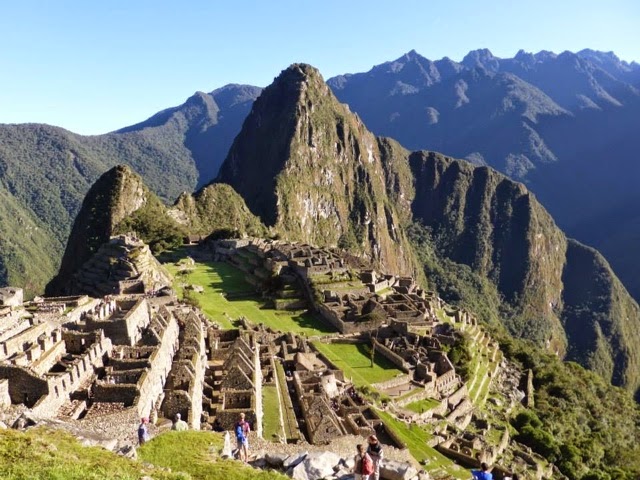
We went in and followed the trail round the hillside, and there it was. Blanketed in shade, but absolutely majestic. Exactly as I'd seen in photos, and exactly as I'd expected, but so incredible to see it with my own eyes. 

I'd recommend going left as you go in and heading up the hill to get the overview and take your photos while it's still relatively quiet, then going and exploring the ruins when it's not as important to have a clear view. And definitely go early to see the sunrise if you can. It's not a red sky deal - the surrounding mountains completely block the horizon - but what you do see is the sun creep above the mountainside and illuminate the tip of Huayna Picchu (the steep peak behind Machu Picchu) with a bright gold. The light gradually spreads down to the ruins and fills each street with golden shafts of light, and the morning humidity means that you can actually see the beams of light. You'll see the ruins half bathed in light and half sleeping in the shade before the whole mountainside and the river below are aglow with the sunlight. It's a fantastic sight. 


And as soon as the sun is up you'll need your sunblock and hat. Being so close to the Equator the sun is intense, but I was just delighted that we had clear blue skies. It was exactly how I'd imagined. (It did cloud over that afternoon though, so if you go in rainy season like I did - it will be quieter than peak season in May to August - that's another reason to go in the morning, as it tends to rain mid-afternoon every day, or at least cloud over). 

After taking the obligatory postcard photos from the top of the hill, we did a 20-minute trail to the Inca drawbridge. The bridge itself wasn't amazing, but the views from the narrow cliff-hugging path suspended above vertical drops into the valley below were worth it. Only go if you're sure-footed and have sturdy shoes though. It was slightly perilous at times. 

We returned to the main site, took some more photos (why the hell not, ey?) and then descended to look around the town itself. 


We were under the watchful eye of Huayna Picchu (aka Wayna Picchu) the whole time. You can climb it by spending a bit more when you buy your main entrance ticket. They let two groups of 200 people go up per day, one at 7am, the second at 10am. Get your tickets even further in advance if you're keen to do this extra. Milena and I were happy with just the main site though. 

The town was fascinating, and we spent almost two hours wandering through the winding alleys and ruined buildings. 


We left Machu Picchu at 10.30am, in need of food and a toilet (there are no toilet facilities inside the site) but very happy. 

What an absolutely amazing day that was. What an unforgettable way to celebrate my 25th. And in the combi on the way back to Cusco we met an American journalist who had been seemingly everywhere in the world. She had a story for every country we could throw at her. Something for me to work towards? Possibly... 


Monday, 31 March 2014

Oh Happy Day

I started volunteering this morning, with a three-hour shift at the animal conservation centre. It was hard work, but it was so cool. They have so many animals! I was really surprised how big it was. I went into some of the safer cages to feed clean and feed the animals, which was great.

And before that shift, I got up early with my host father and we went to buy tickets for Machu Picchu, so that's happening! This weekend Milena and I are staying in Aguas Calientes overnight and going up to Machu Picchu early on Sunday morning. I'm so excited. And it's my 25th birthday the following Wednesday, so what better birthday present to myself is there than a visit to one of the most iconic places in the world? 

And the good times continued with my first Spanish lesson this afternoon, which are included in the volunteering fee. I opted for private lessons, because when given the choice between group lessons or a private lesson where the focus is on your individual needs, what are you going to choose? 

It was a real confidence-boost. The teacher, Roberth, seemed impressed when I said that I'd got to where I am through self study. But I want to be better. So this evening I came back with fresh enthusiasm for Spanish study and did my homework. Gotta love those verbs. 

It's nice to have a routine, even if that routine does involve getting up at 6.45. And I'm very happy with my host family and the other volunteers I'm living with. Tomorrow night I'm going to a salsa class (free provided by the charity I'm working with) and then I've read that there's a place nearby that does good fish and chips. Cue drool. So that's getting a visit after we salsa our feet sore. I used to do salsa at home so it'll be nice to rekindle that old flame. As a disappointing addition, we went to find the Real McCoy British restaurant, and it closed down a few months ago. Wasted drool. 

I'm building a nice life for myself here in Cusco. It's just a shame that in two weeks I'll be back in the road and it'll just be a memory. I'll enjoy it while I have it. 

Sunday, 30 March 2014

Cusco, the City in the Clouds

I arrived in Cusco (Cuzco in Spanish) on Thursday morning. I'm here for two weeks of volunteering, which starts tomorrow, and for sightseeing. Cusco is the closest big city to Machu Picchu, so has quite a large tourist population.

The thing about Cusco is that it's in the mountains. And I mean, high in the mountains. At an ear-popping 3,400 metres above sea level, it's easily the highest I've been in my life. It also means that altitude sickness can be an issue for many visitors to this fine city (which is so much nicer than Lima by the way). 

First off, altitude sickness can be fatal, so it's a fun bugger. There are some horrible possible symptoms, including fainting, vomiting, diarrhoea, headaches, insomnia, death... You know. 

So it's recommended not to fly here from sea level, but to gradually acclimatise as you ascend. This didn't work with my schedule, so unfortunately I had to fly. And I have to say, I have been fine so far. I did take precautions though. I bought some Sorojchi altitude sickness pills in Lima and took my first one on the plane. A box of 20 pills cost 40 soles. I also drank two cups of coca tea (mate de coca) at Lima airport. They sell it for 3.50 soles. The locals drink it to stave off the effects of altitude. I also drank a lot of water, because the headache associated with el mal de altura can be caused in large part by dehydration. 

When the plane opened its doors and I made my way out I had the oddest sensation. I felt like I, and everyone around me, was moving in slow motion. My legs were heavy, as if I were wading through treacle. And I was a bit lightheaded. The air was noticeably different. 

But within a few hours I felt relatively normal, but very tired. I slept very well on Thursday night. 

I think I've pretty much acclimatised to the thin air now, without too much heartache. But walking is hard work, especially uphill. I get out of breath very quickly. 

But I tell you what, it's worth it for the views. Cusco was built when its founder decided he had found 'the naval of the world'. It's nestled in an Andean valley surrounded on all sides by rolling mountains, and snow-capped peaks stand sentinel at one end of the city. You can see the mountains wherever you can see the sky in Cusco, which is lovely. 


The climate is really nice here too (at least it is at the moment, as the last clutches of rainy season lose their grip). The days are warm, but the sun is really intense so it feels much hotter than it is. And the nights are quite cool, if not cold. It's the best of both worlds, because you get the pleasant weather without the uncomfortable sweaty nights. 

This morning my housemate Sarah (I'm doing a homestay for the next two weeks, with an incredibly sweet retired couple) and I took a minibus to Pisac. Pisac is a small village about a 45 minute drive from Cusco. We went to the huge market they have there on Sundays and spent the morning wandering through the alleyways perusing the souvenirs, jewellery, alpaca hats, dolls and food. I ticked two Peru essentials off my list - I bought a bracelet and an alpaca hat. My excuse for the hat is that I'm going to autumnal New Zealand soon, and I'm going to need a warm hat. And for 10 soles, who can argue with the Peruvian price? 

And now I'm going to go to sleep (lack of oxygen, you know...) and get up early to try and book train tickets for Milena and I to go to Machu Picchu next weekend. (Milena is currently in Bolivia after we went our separate ways in Argentina but her flight to the US leaves Cusco next week so we're going to the big MP together before she leaves). 

Then I've got my first morning volunteering at the animal conservation centre, so fingers crossed everything goes smoothly! 

San Pedro Lodge, Iquitos

I decided that San Pedro Lodge deserves its own post, because it made my stay in the Amazon comfortable, enjoyable and unforgettable.

Located about 45 minutes from Iquitos airport and 90 minutes from the main port of Iquitos, the lodge is nestled on a hill just above the riverbank (during high-water season) in the small San Pedro village. 

Its owners are fantastic. So helpful and flexible, and easy to talk to. There's a nice communal area enclosed in mosquito netting, with the eating area and the kitchen, with some board games under the table. That's in the main building, the only one that has electricity, so you can charge your electronics during the evening. There's also a covered area with hammocks that overlooks the garden sloping down to the river. There are two cats and a dog who play around the site as well. 

The food they serve (breakfast is included, lunch is included when you do day tours, and sometimes dinner too, otherwise dinner is 15 soles) is fantastic. There's a great mix of fish, meat, vegetables, rice, pasta, potatoes and beans. It's all very fresh and the portions are good. They also cater to vegetarians. 

The bungalows are clean and comfortable. There's no glass on the windows, just mosquito netting, which allows a good breeze to flow through the room during the night. Mosquito nets are also provided on all beds. The roof is thatched, and there are small holes in it, but I had no unwelcome encounters with any animals in my bungalow. 

The toilets are clean and flush well. The sinks work fine too. The showers aren't warm but the pressure is good. 

They organise day tours which you can book onto when you arrive, and as with me, if you're travelling alone and there aren't enough people to do one of the set tours, they can arrange a private guide that you pay directly. I did their jungle tour the first day, and then I made my own itinerary for the second day.

It's a not-for-profit organisation, and you won't find better prices for a similar thing in the area. The airport transfers and boat transfers from lodge to Iquitos are included in the room price. The vibe there is really chilled. I made some great friends in just three days there. 

I would absolutely recommend San Pedro Lodge if you're looking to stay in the jungle rather than an air conditioned pool resort in Iquitos. It isn't too far into the jungle, so if you're looking for absolute seclusion you might want to consider somewhere further in, although you will pay more. 

If you go to this lodge, you will have a blast. I've already recommended it to friends, and I like my friends, so you can trust my recommendation. Go and enjoy it!