Showing posts with label South America. Show all posts

Monday, 23 June 2014

The Travelling Miles Incredibility Awards - South America

While I've got some down-time here in Melbourne now I'm jobhunting and sorting my life out, I thought a bit of a reflection of my three months in South America was in order.

I loved my time there, and I can't put my finger on the best bit, so let's try for best bits

I can only comment on where I've been, so the following delightfully TMI Awards will be allocated to Brazil, Paraguay, Argentina, Peru, Bolivia and Chile, and cities/places within. 


Best cities: 

1. Rio de Janeiro, Brazil. 


The sun, the sand, the parties. I miss it already. 

2. Valparaíso, Chile. 


A vivid graffiti-infused seaside culture bomb. 

3. Buenos Aires, Argentina. 


Sexy tango dens mixed with European-style glamour. 


Worst cities: 

1. Uyuni, Bolivia. 

The only reason to go is the salt flats. 


2. Ciudad del Este, Paraguay. 

The only reason to go is to get the passport stamp. 


3. Lima, Peru. 

The only reason to go is to leave. 


Most impressive natural wonders: 

1. Iguassu Falls, Argentina-Brazil border. 


Unforgettable sights at every turn. The Devil's Throat is unmissable. 

2. The Amazon Rainforest, Peru (for me). 


A wonderland of natural beauty, calm waters and life as you've never seen it. 

3. Salar de Uyuni, Bolivia. 


A pure, surreal landscape dotted with glowing mirages. 


Most impressive manmade wonders: 

1. Machu Picchu, Peru. 


Not original, but nothing else beats it for me. 

2. Rio Carnival Samba Parade, Sambodromo, Brazil. 


The most colourful, insane night of my life. Stay til sunrise to get the most out of it. 

3. Humberstone, Iquique, Chile. 


A deserted mining town now half-reclaimed by the world's driest desert. 


Best beach: 

Ipanema, Rio de Janeiro, Brazil. 


Hands down the best. Watch sunset from the rocks - absolutely gorgeous. 


Best mountain scenery: 

Bolivia. 


The volcanic colours were fantastic, against a backdrop of pure blue sky. 


Best landscape: 

Valle de la Luna, San Pedro, Chile. 


Watch sunset over the smoking volcanoes and watch the yellows turn to reds and purples over the pockmarked desert valley. 


Best sunrise: 

Machu Picchu, Peru. 


It's an unconventional sunrise, but the shafts of golden light illuminating the city on the mountaintop was a sight to behold. 


Best sunset: 

Middle of freakin' nowhere, Bolivia. 


I don't need to add anything to this photo. 


Easiest Spanish to understand: 

Peru. And everyone loves the Colombian accent. That's where I'm going to study it, in my dreams. 


Hardest Spanish to understand: 

Chile. Like, seriously. 


Most welcoming people: 

Chile. Like, seriously. 


Least welcoming people: 

It's a toss-up between Peru and Bolivia, which I think is linked to the poverty levels. 


Safest country: 

Chile. But still watch your stuff. 


Least safe country: 

Peru. I felt unsafe in Peru more than any other place. Just exercise caution. 


Easiest country to get around: 

Peru. Extensive bus network, and you can book online with ease if necessary. 


Hardest country to get around: 

Brazil. Foreigners can't book buses online, and also the country is massive, but that's not Brazil's fault. 


Places that most deserve a re-visit: 

1. Argentina. I want to explore so much more of that beautiful country, especially Patagonia in the south. 

2. Rio de Janeiro, Brazil. What can I say? I fell in love with that place. 


And 3. The whole damn continent.


#TMIawards #TMI


Thursday, 15 May 2014

No Pink This Week

Oh New Zealand! Right from when I stepped off the plane I was comfortable here. It's so similar to Britain. Wandering round Auckland this afternoon I felt like I could be in a district of my hometown that I just hadn't been to before. 

But a big difference is the cleanliness. I barely saw any litter on the streets all day. I'd been told that New Zealand is a clean country, but it's a really clean country. And everyone I've come across has been very friendly. And I feel so safe, even wandering round unfamiliar city streets at 6am this morning. So far, this country is doing it right. 

Getting here was on the shortest 13 hour flight ever, after my 24 hours on a bus last week. That trip actually feels like ages ago. So much has happened between then and now. 

And now, here I am, missing a Wednesday from my week and a bit sleep deprived, but wandering round the town made me feel very at home. For one thing, it rained. I haven't seen rain in weeks. But the temperature is comfortable, about the same as Santiago was. So I haven't been thrown in at the deep end just yet. 

Earlier I was thrown into some kind of familiar food-related ecstasy though. I went shopping for lunch, and came across a treasure trove. Baked beans, British tea, Patak's curry sauce, Bisto... And all the Cadbury chocolate I could ever want. And in fantastic flavours we don't have in the UK, like Rocky Road. What did we do to not deserve that!? 

But there's already been some reverse culture shock. I keep wanting to 'Hola' people, and almost throwing toilet paper on the floor, because there's no bin for it, because the plumbing works here! Heaven. And there are no stray dogs. And they drive on the left, so I keep looking the wrong way when crossing the road. South America could kill me yet. 

So on the whole, New Zealand, with its autumnal leaves (I haven't seen deciduous trees in months), Maori language option on ATMs, and singing pedestrian crossings, is hitting the spot. 

Doesn't mean I don't miss Latin America just a little though. 

Tomorrow I start the Kiwi Experience bus tour, heading to the first stop at Hot Water Beach. I'm not sure how beach-appropriate the weather will be, but the area looks beautiful. Time to start my New Zealand adventure! And quite possibly put on weight. I've missed a lot of food... 

Monday, 12 May 2014

Adiós

Tomorrow I leave South America. After three months, six countries, and countless unforgettable experiences. The time has passed unbelievably quickly since the 20th February, when I first touched down in fabulous Rio. This section of my journey ending has kind of sparked a quarter-trip crisis. I certainly didn't think I'd be this sad to be leaving this continent. Not because I didn't like it, because god knows that's not true, but because I didn't think I'd have time to get emotionally attached, having moved about so much. But apparently I can't not get emotionally attached. 

Having said all of this, I am so excited about New Zealand. Travelling there will certainly be easier and less stressful than South America. I wonder if that will make it less exciting. 

My last few days have been here in Santiago. It's a nice city - very modern, with lots of green spaces and an interesting blend of historical buildings and sparkling skyscrapers, one of which is the tallest building in Latin America. This evening I went and watched the sunset from one of Santiago's hills, Cerro Santa Lucia, and had a bit of reflecting time. 

The last few days were made especially nice by staying with my friend who lives here. He very kindly invited me to stay with him, so it's been a comfortable few days. And on Friday night I met up with a couple who were on my salt flat tour, so it was nice to see them again. 

I'm not planning a wild last night, but I think there might be wine involved at least. Chilean wine is so good, and half the price it is in the UK. 

And even though I'm taking a giant step across the Pacific tomorrow night (and losing a day in the process) it's definitely not goodbye to Latin America forever. In the last three months I've just scratched the surface of what this place has to offer, and my head is brimming with ideas for future trips. So I guess it's not adiós, it's more hasta pronto. And I feel better about that. 

Wednesday, 7 May 2014

Oh Valpo

I survived my 24 hour bus journey! It was intense at times, and I kind of hated myself for not spending twice the money on a two hour flight, but in the end money lasts longer than the discomfort.

And they played some alright films, so I barely listened to my iPod and I didn't touch my book. So I suppose that's a good thing. 

And it was absolutely worth the long trip to be here in Valparaíso. It is such a beautiful city. It's actually vying for the top spot of my favourite South American cities, which at the moment is held by Rio. I'll see how I feel in a few days, but it's close. 

Valpo is a seaside town about two hours west of Santiago. It's funky and arty, and full of interesting graffiti on the sides of multicoloured houses, opposite old colonial churches, all built into a hillside traversed by funicular trams overlooking the Pacific. 


I've fallen in love, and I've been here for seven hours. When I stepped off the bus, into the sun and fresh air (!), it seemed like everyone was smiling. There's a definite feeling of good vibes here, and I don't think that's just me being high off sea level air after coming down from the mountains. 

I've got tomorrow here as well, and then I'll rustle me up a bus to Santiago in the evening. A friend of a friend is meeting me at the bus station and we're going for dinner, and on Friday night I'm going to meet up with the French-Colombian couple I met in Bolivia. A nice final few days in South America. 

So while I'm lying on this very comfortable bed in a Valpo and cheap Chinese food-induced coma, I think I'll prattle on about Chile in general. Oh, but first, speaking of this bed - I'm staying at Casa Volante Hostel, and it's lovely. Very welcoming, great showers, kitchen and common room. And not too expensive either. There's a Miles recommendation for you. 

So Chile. I really like Chile. It's one of my favourite countries I've been to on this trip, up there with Brazil and Argentina for atmosphere and general buzz. 

The people are incredibly warm, welcoming and patient with foreigners who don't speak Spanish very well (ie me). Much more so than in Peru. I often found the average Peruvian seemed to have a bad taste in their mouth when they came into contact with foreigners, and it was the same in Bolivia. I wonder if there's a correlation between the wealth of the population and the friendliness towards tourists. There could be some disdain in the poorer nations. But anyway, that's not the case in Chile, because I've found Chileans to be the most open of all South American people. 

It's a country of incredible contrasts, with the north being enveloped in the world's driest desert, and the south bring home to Patagonia, a wonderland of snowy mountains, glaciers and perfect lakes. Unfortunately I won't make it any further south than Santiago, but I'm hoping that New Zealand will fulfil my need for fabulous scenery. And Chile doesn't have Mt Doom. 

Chile doesn't want you to buy anything. In shops that are any more specialist than an average corner shop, you'll have to tell the person behind one counter what you want, then take a ticket to another counter to pay, where you'll be given a receipt to collect your items from a third counter. Jobs for all! 

Chile is still a developing country, but the government is aiming to become a first-world country by 2020. And it's well on its way. It has a good infrastructure, helped enormously by the impressive Pan-American Highway that runs north to south. Things also seem to work here, which is nice after spending over a month in Peru. And Chile's economy is strong, which leads me to my next point. 

Chile isn't cheap. After coming from Peru, it was a bit of a shock. I haven't spent £10 on a dormitory room since Rio, but northern Chile seems to think rather highly of itself. But it is a nice country, so I'm prepared to spend a bit more to be here for a while before I jet off to the second "other side of the world" of my trip. 

In short... Chile. I'm a fan.

Monday, 5 May 2014

Salt Flats Tour from San Pedro

And with this weekend passed, I have ticked off the major sights of South America I came here to see. And what a sight it was.

But I'll start from the beginning. 

I booked my tour with Cordillera, which is generally considered to be the best of a bad bunch of tour operators that do the Salar de Uyuni (Uyuni salt flats) trip. I needed the three-night option that brings you back to San Pedro de Atacama in Chile. You can start in either San Pedro or Uyuni, Bolivia, and finish at either city. It cost me 116,000 Chilean pesos for the tour, including accommodation and food, and even wine on the second night. 

So on the first day, Friday, I was picked up from my hostel at 8am in a big minibus that took us to the Bolivian border, 50km into the mountains. We stopped at the Chilean border control first, which was the slowest border I've been to. But while we were waiting it gave us all a chance to chat and get to know each other. There were two jeeps' worth of people (12 in total), and it was a really interesting mix of South American and European. We were separated into our jeeps by people who were returning to Chile and people who were finishing in Uyuni. And by a stroke of luck I was with the people I'd be speaking to most - a charming Danish couple, a French-Colombian couple living in Santiago, and a Brazilian architect on holiday. And three of them spoke fluent Spanish! This is really luck of the draw, because chances are the driver won't speak a word of English. 

At the Bolivian border, which consisted of a shack, a small office and a 'baño natural' (aka a wall), we got our entry stamps. They didn't ask to see my yellow fever certificate though, which I'd read was a requirement to enter the country. Maybe that's only if you arrive somewhere like an airport, rather than through a dusty mountain pass. 

After an al fresco breakfast of bread, ham, cheese and hot drinks, we were off into Bolivia. And the road quickly transformed into a dirt track, and it stayed like that until we returned to Chile four days later. We chatted a bit to the driver, Felix, who was amiable but silent for the most part. He was the seventh member of our group, travelling in the cramped jeep with our luggage strapped to the top. If you're tall like me, you might need to do some serious stretching each evening. But in general we stopped quite often so there were plenty of opportunities for standing and walking around. 

We got to the entrance to the national park and paid our 30 Bolivianos each. And then we started to see some sights. The first two days could be renamed 'The Lagoon Tour', because the actual salt flats aren't until the third day. But the lagoons are pretty fabulous in their own right. We stopped at Laguna Blanca and Laguna Verde first. Both were bookended by incredible mountain scenery. The desert colours in San Pedro are remarkable. In Bolivia they are incredible. 


The next lagoon of note was Laguna Colorada, a stretch of water covered with red algae, watched over by stoic llamas and flocks of pink flamingos. That was a great sight. We were there until just before sunset, when we returned to our hotel, just ten minutes' drive away. 


The hotel for the first night is at 4,900 metres above sea level, so it is cold. And the risk of altitude sickness is high. No one in our group suffered, thankfully, but it might be worth investing in some altitude sickness pills or coca products. 

My jeep were all in the same room for this night, but that probably kept us warmer in the end. There's no heating and no hot showers here, so none of us showered. If you're going to smell, you may as well smell together, right? 

We had a good dinner of mashed potato, sausages and vegetables. Bangers and mash! They knew I was coming. And the food over the whole trip was very good - good portions (always important) and hot and generally tasty. We did sometimes spot other companies with a much more lavish spread than ours though, so we got a bit of food envy at times. 

That night it got to -25 Celsius outside, and around 0 in our room. You can rent sleeping bags for 50 Bolivianos from each hotel, but I slept in a t-shirt, fleece, Long Johns and thick socks and I was okay with the blankets they gave us. 

Day two was the dullest of the three days of sightseeing (the fourth morning was simply driving back to San Pedro). Breakfast was at 7am and then it was off for more lagoons. Be still my beating heart. The highlight was probably el árbol de piedra (the tree of rock), but that didn't exactly bowl me over. 

Late that afternoon we arrived at our accommodation for the night - a salt hotel. I'd heard of this before the tour, but couldn't imagine it. It's a hotel made of blocks of salt, and the floor is powdered salt, and the furniture and beds are all made of blocks of salt. There's a lot of salt. 

Unfortunately one of the five litre bottles of water strapped to the roof of the jeep had had a little accident, and my bag was very wet, but thankfully only on the outside. But what better to absorb water than... salt. 

Here we were put in twin rooms, so I shared with my Brazilian jeep-mate. The rooms were warmer than the previous night, but still basic. And the showers were freezing. Warm would be an overstatement punishable by death, but they were barable enough to have a wash. This was followed by a good dinner, with wine, which was very welcome. And then I went to bed, at something ridiculous like 8pm. But we had to be up at 4.30am to see the sunrise over the salt flats, so it was a wise decision. 

And then yesterday was what we'd all been waiting for. The Salar de Uyuni. 

It was an hour and a half drive to the salt flats, and we got there in time to see a spectacular sunrise. There were spots of mirages on the horizon, reflecting the orange of the sky. I had Circle of Life in my head for hours. 

The rising sun revealed the bizarre moonscape that the salt flats encompass, and that we were standing in the middle of. The flat white salt glowed violet, while the mountains in the distance shone with an eerie purple light. The ridges in the ground caught the sun's rays first and created a giant chessboard of shining white borders on lilac squares. 


We watched the sun until it was above the horizon, giving us great photo opportunities. 


Then we made our way to Isla Incahuasi, a small rise in the middle of the otherwise completely flat landscape. We walked among the ridges and giant cacti that seem to be the only life for hundreds of miles, before having breakfast. 


I should add that it was well below zero degrees. And windy, with nothing to block it. I'm glad we saw the sunrise, but I'm also glad for layers. 

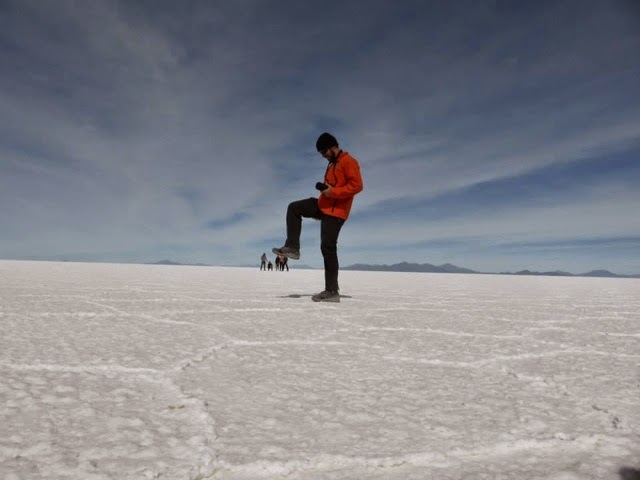
We headed off further into the Salar to take some of those obligatory perception-defying photos. The flatness makes it the perfect place to hold your friends in the palm of your hand, or gather a group in your shoe. But the photos are not easy to take! You need a clear vision of what you want, and you also need someone to lie on the salt (which hurts!) to take it. 


But we had a fun hour and a half taking all the photos we wanted. And to be there, when I'd seen so many photos of the unique place, was fantastic. It wasn't wet season though, so I wasn't expecting any water to be on the ground, which is what gives the Salar its mirror quality. The best time to see it like that is December to March, but if there's too much water then the jeeps won't take you there because the salt water destroys the engine. So you need luck on your side to see that mind blowing sight. 

With a camera full of photos, and red cheeks (wear strong sunscreen!), we climbed back into our jeep and headed to Uyuni. We stopped at a salt museum, which was nothing more than one room with some sculptures made from salt. But there was a collection of world flags blowing in the wind, which made for a nice view with the colours against the pure white of the background. 


There were mirages galore around here, and it's easy to see how people are drawn to them thinking there's a huge lake in the distance. You seriously would not want to be lost anywhere around here. The Salar de Uyuni is the world's largest salt flat, stretching over 10,000km of Bolivian altiplano. 

Our final stop was Uyuni's train cemetery, an atmospheric relic of Bolivia's steam train system. 


But the problem was that it was in Uyuni. Which is not a pleasant place. There were two nice streets in the centre, but apart from that it was a dusty town, roads lined with inhabited yet unfinished, windowless houses. This really highlighted Bolivia's poverty to me. It really is a very poor country. Many people are dirty, children no older than six charge you as you use public toilets you need to pour water into to flush, and there is very little wealth evident. I'd seen areas like this in Peru, but it felt deeper in Bolivia. It made me think: this could be me. It was absolute luck that I was born British, into a white middle-class family. The life of the Bolivians I saw on the streets could easily have been mine, or yours. Maybe this is the beginning of me 'finding myself'. Travelling is making me think! 

The tour part of the trip finished in Uyuni, and the four of us who were returning to San Pedro had to wait an hour for the next jeep with a new driver. We said goodbye to the Danish couple, and the others from the other jeep, and then we were off. It was three and a half hours' drive to Villa Mar, where we stopped in another fleece-in-bed hotel, where you could pay ten Bolivianos for a hot shower. 

The next morning we were up to leave at 6am and headed back to the Bolivian border and its baño natural. We met the people who were just starting their tour, a few of whom had been at my hostel before I left, and passed on some pearls of wisdom. I think my red face gave them one strong hint at least. 

And that brings me to this afternoon. I can already tell I will never forget being in those salt flats. And I'll probably never experience anything like it again. Unless I come back. Who knows what the future holds? 

While I really enjoyed the tour, and met some amazing people who I hope to keep in touch with, I feel like if you're in Uyuni and don't need to use the tour to get to San Pedro, just do a one-day trip into the Salar. It's very close and would do the best bit of the three or four days. That is unless you're a big lagoon fan, in which case you'll love the other days. 

And this leaves me with eight days left in South America, which is kind of boggling my mind right now. Tomorrow I've got a 24 hour bus journey (vom) down to Valparaíso, and then I'll spend my last few days in Santiago before flying to New Zealand. The next stage of my adventure! Can't wait. 


Thursday, 1 May 2014

All the Tours Ever, San Pedro de Atacama

On Monday I took the eight-hour journey from Iquique to San Pedro de Atacama, with a change in Calama. I went with TurBus, which is considered to be the most reputable bus company in Chile, followed by Pullman

San Pedro is a desert tourist town, sitting at 2,500 metres above sea level, close to the Bolivian border. This makes it an ideal spot for jumping off into a salt flat tour, and either stopping in Uyuni to explore Bolivia, or doing a full circle back to San Pedro. I'm doing the circular route because my flight leaves Santiago in a couple of weeks so I need to come back to Chile. That route cost 1116,000 Chilean pesos with Cordillera. By all accounts that's the most trustworthy company. Be really careful who you go with, because tales of faulty jeeps and drunk drivers abound when it comes to the salt flats. 

But there's so much to do in San Pedro itself too. There are a lot of tour companies offering various packages, but they basically all do the same things. 

Two days ago I did a tour to Moon Valley, where it's rumoured George Lucas filmed some of A New Hope. And walking through the jagged peaks and sandy rocks, I was half expecting a Jawa to pop out. We also went into a really tight salt cave, where I had to bend double to one side to get through. And that tour ended with one of the most spectacular sunsets I've ever seen. The sun goes down behind the mountains on one end of the valley, and illuminates the volcanoes on the other, sending them orange and then purple, while the clouds above turn red and the ground below glows yellow. Absolutely amazing. And there's a section of rock that juts out over the valley, which makes for a pretty great photo. 


That cost me 10,000 plus 2,000 pesos for entrance to the national park, with Maxim Tours. Note that the tour I did didn't include Death Valley, even though I´m pretty sure they said it would. 

Yesterday I got up early to do a tour to the El Tatio geyser field and watch the sunrise. We got up to leave at 4.30am with a hostel pick-up, and did the 90 minute journey, climbing 2000 metres to 4,300. And it was so cold! Minus 13 Celsius. And thanks to the mild winter in the UK this year, I haven't felt cold like that for almost two years. And I didn't have gloves. Not fun. 

But the sunrise and the geysers were really interesting, and there was an option to swim in the hot spring there. On the way back we stopped at Machuca village, a beautiful place which is home to a total of six people. 


That tour cost me 17,000 plus 5,000 pesos for entrance and included a good breakfast, with Desert Adventure

And tonight I'm going star gazing. The Atacama desert is one of the best places in the world to see the night sky, due to the lack of light pollution, the amount of cloudless nights and the predictable winds from the Humboldt current from Antarctica. 

Everyone I've spoken to has said it's amazing, and through the largest visual telescopes in South America you can see galaxies, shooting stars and the rings around Saturn. 

I went with SPACE (San Pedro de Atacama Celestial Explorations), which is highly recommended by Lonely Planet. That cost me 18,000 pesos for a two and a half hour tour in English including a hot chocolate. The tours are weather-dependent. 

As an update, the star gazing was absolutely fantastic. The sky is a complete blanket of twinkling lights. I heartily recommend this tour. 

There are a whole host of other things you can do, but I just don't have the time or budget. Other highlights for me would be sandboarding, a late-night desert party (so disappointed I can't do that!) and Cejar lagoon, which is Dead Sea-level salty. A lot of people hire bikes and do the trails round here, which is a lot cheaper than doing organised tours, so that's a good way to keep the cost down, because catering to tourists, this town is not cheap! 

After star gazing this evening I'm going to get an early night and then it's off into Bolivia! So excited to see the salt flats. I'll be back on Monday, hopefully with a good story or two! 

Iquique and the Ghost Towns

From Arica I headed south to the coastal city of Iquique, another place famous for its surf. It's also where the large earthquake hit a few weeks ago. I was a bit unsure about whether to go, because I wasn't sure what state the city would be in, but I'm glad I did because apart from some pretty hefty cracks in the roads (which could have been there before) there was no sign of any disaster. I'm also planning to go to Valparaíso next week, where there was a fire shortly after the earthquake. What's going on, Chile!? It´s basically the Big Olive from Hercules. 

I had two nights in Iquique, and the first day I just spent some time exploring. There are some lovely Georgian buildings in the centre, and a very nice central square. But the beaches are also nice. It wasn't warm enough to sunbathe, but I did have a good wander up and down the front. 

It's interesting actually. Iquique sits on the coast, but you have to climb a steep road to drive out to the desert above, and a semi-permanent haze seemed to hang heavily over the city, but the desert above was clear with deep blue skies. It was the same on the way there from Arica. At one point we descended into a sandy valley which was full of mist, but the land above was bathed in sun. I guess the humidity gets trapped in the valleys. 

My second day was the reason I even stopped in Iquique. I did a tour to an oasis town called Pica, but what I wanted to see were the old deserted mining towns on the way. We stopped at Santa Laura and Humberstone, which are both worth seeing. 

These were once self-contained towns where thousands of people lived and worked mining the nitrate-rich desert. This export is what Chile's economy was based on for decades, until Germany developed artificial nitrate, and the mines, and towns too, were abandoned in 1960. The desert sands took over and now the buildings are empty shells of rusted corrugated iron and fraying wood. 


Wandering round them was fascinating. It's not often that I'm that grabbed by historical sites, but I loved these towns, especially the larger Humberstone. The living quarters were particularly atmospheric. Maybe I've seen too many psychological horrors but when I came across a playground near the old school with an empty swimming pool, still with diving boards hanging over nothing, and a swing-set with one swing remaining, I could almost hear the screams of playing children. Very creepy indeed. 


You can take a tour from Iquique that includes the ghost towns, or you can take a bus or colectivo to Humberstone and then catch any bus to Iquique from the bus stop outside, but buses can be few and far between to get back. They're absolutely worth it though. They're like nothing I've ever seen before. 

Monday, 28 April 2014

The Holy Grail

Yesterday I found English Breakfast tea in a supermarket in Iquique. In the random Waitrose section right next to the cheese-flavoured noodles.

I am so happy. I will never leave home without it again.


Saturday, 26 April 2014

Tacna, Peru to Arica, Chile by Bus

Yesterday I left Peru and the five weeks there behind me, and entered a new country! I was really excited to go to Chile, if only for a change of scene. But also I can't wait to explore the Atacama desert.

I got a Flores bus from Arequipa to Tacna, which was advertised as taking five hours, but actually took six. The journey south was through very rugged terrain at times, the road clinging to the sides of valleys seemingly made entirely of golden scree. Then we went into the desert proper, and I had my first views of all-encompassing, horizon-hugging nothingness, only broken occasionally by the waltz of power cables across the landscape. 


I met a very nice couple on the bus, Amy and Cody, and they were going to Arica as well, so we tackled the border together. Arriving at Tacna you need to cross the road to the international bus station and find one of the many people asking if you want a colectivo to Arica, which is basically a taxi which they fill with people and then go. It cost us 20 soles per person. 

They take your passport from you to print off a small form which you need at Chilean immigration. Keep that safe! 

It's 20km to the border from Tacna, and then a further 20km to Arica once you're in Chile. Despite being directly south, Chile is in a different time zone, and due to daylight saving time we lost two hours, despite my iPod insisting Chile was only an hour ahead. There is a digital clock when you go through to prove Apple wrong. 

Then our driver took us to the bus station in Arica and dropped us and our bags there. The three of us bought tickets for our onward journeys, Amy and Cody to San Pedro, and me to Iquique for this morning. 

We walked along the beach, just in time to see a gorgeous sunset, and had dinner near the main plaza. Arica is a really relaxed surfing town, and I liked it a lot, even though I was only there for one night. 


It was also really nice to be back at sea level, as for the last four weeks I've been at least 2,500 metres up in the mountains. But oddly I didn't feel any different, other than not being out of breath after taking two steps. I guess I had properly acclimatised to the thin air, which I suppose is a good thing. 

Right now I'm lying on a very comfortable sofa by a window overlooking the front patio of my beach-adjacent hostel in Iquique, and tomorrow I'm doing a tour to the nearby mining ghost towns and oasises. No complaints my end. 


Friday, 25 April 2014

Colca Canyon

On Wednesday I went on a two-day tour to Colca Canyon, which at its deepest point is twice as deep as the US' Grand Canyon. The tour was organised by my hostel, Wild Rover, and cost 70 soles for the transport, guide, accommodation and breakfast. We had to buy the boleto turístico to actually enter the Canyon separately though, which was an extra 70 soles.

The day before we left I'd spent the day with the girls I met in Rio, and in the evening Camilla, who I met in the same hostel, arrived, so it was a great little ReRionion over tequila sunrises in the Wild Rover bar. 

We were up to leave at 8am and headed out into the mountainous desert in our minibus. We stopped to buy coca products to combat altitude sickness, because to get to Colca Canyon from Arequipa you need to pass over a point that reaches 4,910 metres high. That's now the highest I've been in my life, and I actually felt fine. Maybe the coca sweets did their job really well! 

We arrived in Chivay, the town at the closer end of the canyon, for lunch and an afternoon at natural hot springs along the bank of the river, only accessible by way of a rope suspension bridge over the rushing waters. I met a group of three who had actually met the girls from Rio earlier in their trip, and we spent the next two days together. 

After dinner and a dance performance, which involved me being put on the floor and actually whipped by a woman in traditional dress (don't ask), we got an early night in preparation for our 5.30am start the next morning. 

But it was worth the early hour and the freezing cold, because we got to the Cruz Del Condor viewpoint in time to see the magnificent birds in flight. I'd been around condors at the zoo I volunteered at, but never seen them catch the warm air currents and glide. Really something. 


Apparently it's not easy to see them in flight, but someone in my tour group pointed out that there was a dead cow on a ridge below us, so maybe they're drawn there on purpose for the 9am tourist influx. 

And the canyon itself. Wow. It stretches down to the white river past ridges, pre-Inca terraces, the occasional condor if you're lucky... It's a very impressive sight. But wear sunscreen! I got so burned that morning, and ended up in bed early with sunstroke and a tomato face when we got back to Arequipa. Not a good look. 

We did a short hike along the top of the canyon, and stopped at various points on our way back to Chivay. Each view brought a new sight. If you have time while in Arequipa, this is a highlight you shouldn't miss. Whether you do it in a tour, or by yourself with local buses, you'll have a great time. 


Monday, 21 April 2014

Arequipa

I'm now in Arequipa, Peru's White City. And its second largest city as well. I was prepared to be a bit meh, as I was with Lima and Puno, but Arequipa has earned itself second place after Cusco in my world-famous ranking of Peruvian cities.

I've stayed in two hostels, both in the historical centre, so I can only comment on the area with the cathedrals and pretty buildings. It's this area that gives Arequipa its nickname as the White City, thanks to the volcanic stone the buildings were made from. 

But the best thing about Arequipa is its setting on a plain beneath three snow-capped active volcanoes. My first hostel, Park Hostel, was in a nice colonial building with a fabulous roof terrace that looks over the roofs of the centro histórico over to the volcanoes. What a sight for breakfast. 


From here you can do all manner of trips, including white-water rafting, mountain/volcano climbing, and hiking. Not being an adrenalin-junkie myself, I'm doing a one-night two-day trip to Colca Canyon, which is one of the world's largest canyons, even outdoing the Grand Canyon. That's Wednesday-Thursday, so I've got tomorrow to explore Arequipa some more. 

But the girls I met in Rio (god that feels like ages ago, and it was only two months) are joining me in the hostel I'm in now. It's a full on party hostel, The Wild Rover, which also has branches in La Paz and Cusco. I haven't stayed in a lively hostel like this before. I love a good party, but I tend to like my partying and sleeping to be in separate places. We'll see I guess. Got to try these things! I'll pretend I'm a one-man lads on tour group. 

So anyway, it'll be really nice to see them again. I assume we'll do some kind of sightseeing tomorrow, then I've got Colca Canyon for two days (booked through the hostel - 75 soles for the one-night tour). And then I've booked a bus for Tacna on Friday, and from Tacna I'll go by bus to Arica, in Chile. Then it'll be goodbye to Peru! 

Oh also, I took a Cruz Del Sur bus from Puno to Arequipa, and it was very comfortable. Cruz Del Sur is generally regarded as the safest bus company to travel with in Peru, so it's a bit more expensive than you'd pay with other companies. It cost me 59 soles for the cheaper level (top level) for the five and a half hour trip here. There was a small snack included, and blankets! You still don't get a choice about whether to hear the films they played on the overheard screens though. Four hours of Ben Hur and I was ready to Ben Hurl. But then they played Tangled, which I'd actually wanted to see when it came out. Well done Cruz Del Sur. 

Anyway, my lively hostel awaits my presence. Will update soon! 

Friday, 18 April 2014

Island Tour on Lake Titicaca: The Perfect Storm

Today I went on a day trip from Puno to Uros and Taquile, two islands on Lake Titicaca. And as the title of this post would suggest, it was not the smoothest boat trip I've ever been on. In fact, it was easily the most dramatic. But we'll get to that later. 

Lake Titicaca is the world's highest navigable lake, sitting at 3808 metres high and spanning a whopping 8400km. And it's a beautiful place. It's just Peru's lakeside cities that are a bore. Puno is the dullest place I've been to on my trip so far. I'd even take Lima over Puno. But I'm here for the Lake, not the cities. 

You can do half-day boat trips to just the Uros Islands, full-days to Uros and Taquile, or an overnight which includes Amantani as well. I did the full-day option, which cost 70 soles arranged through my hostel, and included pick-up and drop-off at my hostel, boat trips for the day and lunch on Taquile. 

So without the clocks striking thirteen, or anything else ominous, we left the dock at about 7am, in the freezing cold. Just a note, Lake Titicaca is cold when the sun isn't out. The days are a mixture of t-shirt and hat and scarf weather. 

It took an hour and a quarter to get to the Uros Islands, which gave me time to take in the wide blue skies, glittering clear water, and the islands of reeds underlining snowy mountains on the Bolivian shore of the lake. Uros is a group of manmade floating reed islands, each with half a dozen families living in reed houses, sailing reed boats. 

Stepping onto the island we visited felt like jumping onto a bouncy castle. Underneath the layers of reeds is springy wet earth, anchored to the lakebed with, you guessed it, reeds. And it was a really tiny place. There was a 'square' of sorts with all the houses surrounding it in a circle. It was a surreal experience, wandering round the stalls the locals had set up (caution: it's very touristy), all the while thinking that you're walking on bobbing reeds. All the houses had solar panels as well. Doing better than the UK already. 


Another hour and 20 minutes away was Taquile, a natural island. It was tall, with its summit just overtaking the 4000 metre mark. It was a place of vibrant greens and blues, and steep paths climbing to where we had our lunch of trout from the Lake near the main plaza. Lunch was followed by a traditional dance, which involved some audience participation. There was also a finger post to different cities in the world in the plaza, which took up most of my photographic energies. I met some really cool Brazilians who work in London, so we spent most of the afternoon chatting. 

At about 2.30pm we left Taquile and started the three hour journey back to Puno. We left with beautifully clear sky, and a rosy pink neck in my case. But it quickly clouded over. I'd been expecting this, as pretty much every afternoon I've had in Peru has ended up with some rain. 

This was more than some rain. The wind was whipping round the boat, rain hammering against the windows, and the waves creating a rollercoaster of water, the mountains disappearing in splashes of grey every few moments. I kept my eyes on the horizon to avoid seasickness, which worked very well. This had been going on for about 15 minutes, and I was contently bouncing around listening to Ke$ha. That's when the front window smashed in. 

A huge wave had reared up and thrown the majority of the window on top of the driver. He and the first two rows of passengers were soaked, glass floating around on the floor. No one quite seemed to know what to do. The boat was still rising and plummeting with every wave. 

The driver was okay, save cuts on both hands. But water was still splashing inside the boat, the structure creaking with every rise and fall. I heard a woman throw up behind me. 

One of the Brazilian girls at the back of the boat started to hand out life-jackets. She called out my name and gave me the first one, but my conscience forced me to pass it down to the front, and that continued until they were all gone. And there wasn't one left for me. Great health and safety, Peru. 

There was a life-ring though, for four of us without jackets to share. The storm continued for half an hour, but it felt like a lot longer. We finally rounded the peninsula and the wind died down, leaving us bobbing rather than ferociously dipping. 

Everyone was calm, and once the waves subsided and the driver had seen to his hands and thrown the shattered glass overboard the Titanic jokes and calls of "Jack!" began. 

It did get choppy again, but the driver had left the boat on automatic. Even when other boats came worryingly close he didn't seem phased enough to re-take the wheel. 

And by the time we pulled into the dock at Puno the weather had calmed down a lot. The wind was still strong, and cold, but we were mainly unscathed. 

And that ended my Lake Titidrama. It was quite enough excitement for me for one day. Tomorrow I'm going to Arequipa, which sits between several active volcanoes on the northern corner of the world's driest desert, so I think I'll be safe from water there. Just got to hope my arrival doesn't trigger an eruption, ey?